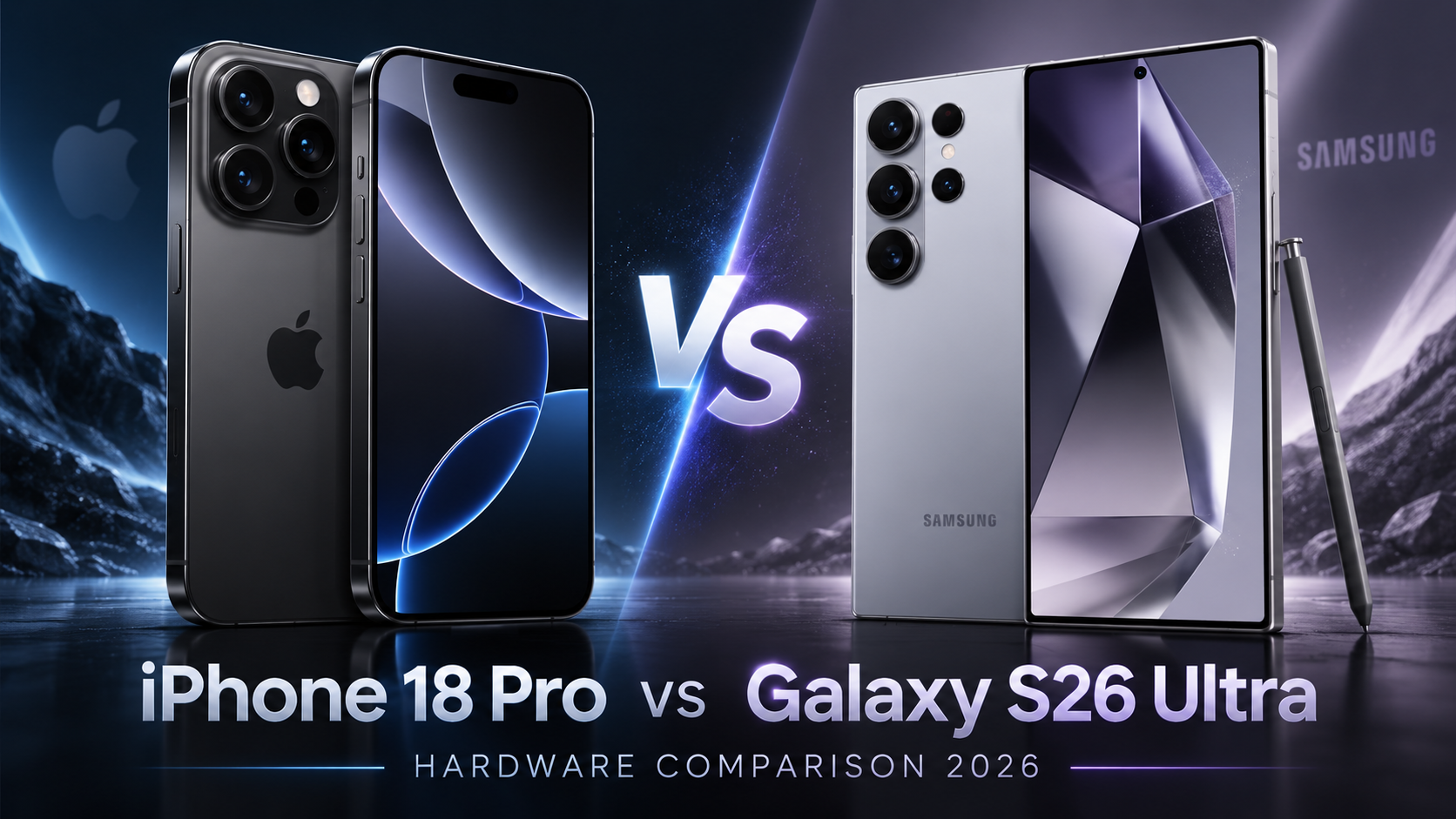
Two flagship phones. Two completely different approaches to smartphone engineering. One question everyone is asking: iPhone 18 Pro or Samsung Galaxy S26 Ultra?
The battle between Apple and Samsung has entered a new generation.
With Apple launching the iPhone 18 Pro and Samsung already competing at the premium end with the Galaxy S26 Ultra, smartphone users are not just comparing cameras or design anymore. Processor architecture, thermal management, display technology, charging systems, AI hardware and camera sensors are becoming equally important.
For anyone interested in smartphone technology, mobile hardware and chip-level engineering, these two devices offer a fascinating look at how modern smartphones are built.
So, when we look beyond the logos, which phone offers the more interesting hardware package?
Let’s compare the iPhone 18 Pro vs Samsung Galaxy S26 Ultra in detail.
|
Specification |
iPhone 18 Pro |
Samsung Galaxy S26 Ultra |
|
Display |
6.3-inch Super Retina XDR OLED |
6.9-inch Dynamic AMOLED 2X |
|
Refresh Rate |
Up to 120Hz |
Up to 120Hz |
|
Processor |
Apple A20 Pro |
Snapdragon 8 Elite Gen 5 for Galaxy |
|
Main Camera |
48MP variable-aperture Fusion camera |
200MP main camera |
|
Ultra-Wide |
48MP |
50MP |
|
Telephoto |
48MP |
50MP + 10MP |
|
Storage |
256GB to 2TB |
256GB to 1TB |
|
Battery |
Up to 34 hours video playback |
5000mAh |
|
Wireless Charging |
MagSafe/Qi2 up to 25W |
Supported |
|
Water Resistance |
IP68 |
IP68 |
|
Starting Price in India |
₹1,64,900 |
₹1,39,999 launch price |
Apple officially lists the iPhone 18 Pro with a 6.3-inch OLED display, A20 Pro processor and a three-camera 48MP Pro Fusion system. Samsung lists the Galaxy S26 Ultra with a 6.9-inch Dynamic AMOLED 2X display and a 200MP + 50MP + 50MP + 10MP rear-camera system.
The first major difference between the iPhone 18 Pro and Galaxy S26 Ultra is their physical approach.
Apple's iPhone 18 Pro features an aluminium unibody design, Ceramic Shield 2 on the front and Ceramic Shield on the back. It weighs 211 grams and measures 8.75mm thick. Apple also rates the device IP68 for water and dust resistance.
Samsung's Galaxy S26 Ultra takes a larger but surprisingly slim approach. It measures just 7.9mm thick, weighs 214 grams and uses an Armor Aluminum frame. Samsung uses Gorilla Armor 2 on the front and Gorilla Glass Victus 2 on the rear, along with IP68 protection.
Interestingly, despite the Galaxy having a considerably larger display, its weight is only slightly higher.
For users who prefer a more compact flagship, the iPhone 18 Pro size may be attractive. Those who prefer a larger screen for gaming, content consumption and productivity may find the Galaxy S26 Ultra's form factor more suitable.
Searches around iPhone 18 Pro display, Galaxy S26 Ultra display and iPhone 18 Pro vs S26 Ultra screen are especially relevant because the two phones are noticeably different here.
The iPhone 18 Pro comes with a 6.3-inch Super Retina XDR OLED display with a resolution of 2622 × 1206 pixels.
It also supports:
The Galaxy S26 Ultra uses a much larger 6.9-inch-class Dynamic AMOLED 2X display with a 3120 × 1440 resolution and refresh rates up to 120Hz.
Samsung also introduces one particularly interesting hardware feature: Privacy Display.
When activated, the system reduces visibility from side viewing angles, helping protect sensitive information from people looking at the screen from beside the user. Samsung describes it as a built-in privacy-screen technology unique to the S26 Ultra.
This shows how smartphone display engineering is moving beyond resolution and refresh rate into privacy and intelligent display technology.
At the centre of every modern smartphone is its chipset.
And the iPhone 18 Pro vs Galaxy S26 Ultra processor comparison is one of the most technically interesting parts of this generation.
Apple A20 Pro
The iPhone 18 Pro is powered by Apple's A20 Pro chip.
Apple lists:
Apple has also paired the chipset with a next-generation vapor chamber to improve sustained performance and thermal management.
Samsung uses the Snapdragon 8 Elite Gen 5 Mobile Platform for Galaxy.
Samsung says the customised platform improves CPU, GPU and NPU performance compared with the previous Galaxy generation and supports demanding applications including gaming, AI processing and video editing. The Galaxy S26 Ultra also uses a redesigned vapor chamber for improved heat dissipation.
Modern smartphone performance therefore isn't simply about processor speed anymore.
Chip architecture + thermal management + AI processing + power efficiency all work together.
That is also why understanding smartphone hardware requires much more than simply knowing how to replace individual components.
This is where the iPhone 18 Pro camera vs Samsung Galaxy S26 Ultra camera comparison becomes especially interesting.
iPhone 18 Pro Camera
Apple uses a 48MP Pro Fusion camera system featuring:
The biggest hardware change is the variable-aperture main camera.
The main lens can operate at multiple aperture settings including f/1.48, f/1.8, f/2.8 and f/4.0, giving the camera greater control over light and depth of field.
Samsung uses a four-camera rear system:
Instead of looking only at megapixel numbers, technicians and technology enthusiasts should pay attention to the complete camera module — sensor size, aperture, image processor, stabilization hardware, lens system and software processing all influence the final result.
Battery technology is another major factor in searches for iPhone 18 Pro vs Galaxy S26 Ultra battery life.
Apple does not advertise the battery primarily by its mAh capacity. Instead, it rates the iPhone 18 Pro for up to 34 hours of video playback.
Apple also says the iPhone 18 Pro can reach around 50% charge in approximately 15 minutes when used with a compatible 60W-or-higher adapter and appropriate charging setup.
MagSafe and Qi2 wireless charging are supported at up to 25W.
Samsung equips the Galaxy S26 Ultra with a 5000mAh battery and rates it for up to 31 hours of video playback. Samsung's Super-Fast Charging 3.0 can reach up to 75% in 30 minutes under supported conditions.
Real-world battery life, however, depends heavily on display brightness, mobile network usage, gaming, camera usage, background applications and other factors.
The iPhone 18 Pro comes in:
256GB | 512GB | 1TB | 2TB
Samsung offers Galaxy S26 Ultra configurations reaching up to 1TB, including a 16GB RAM/1TB version in India.
The move toward larger storage capacities reflects another major change in smartphones.
High-resolution photos, 4K and 8K video, AI models, games and professional applications require significantly more storage than smartphones did only a few years ago.
The most interesting part of the iPhone 18 Pro vs Galaxy S26 Ultra comparison isn't simply deciding which specification is bigger.
Look inside the technology.
Modern flagship smartphones now combine:
A smartphone may look simple from the outside, but inside it is one of the most complex consumer electronic devices people use every day.
And as smartphone technology becomes more advanced, understanding mobile hardware, troubleshooting and chip-level technology becomes increasingly valuable.
At Magnus Institute of Technology, students don't have to look at smartphones only as consumers.
They can learn how smartphone technology works from the inside.
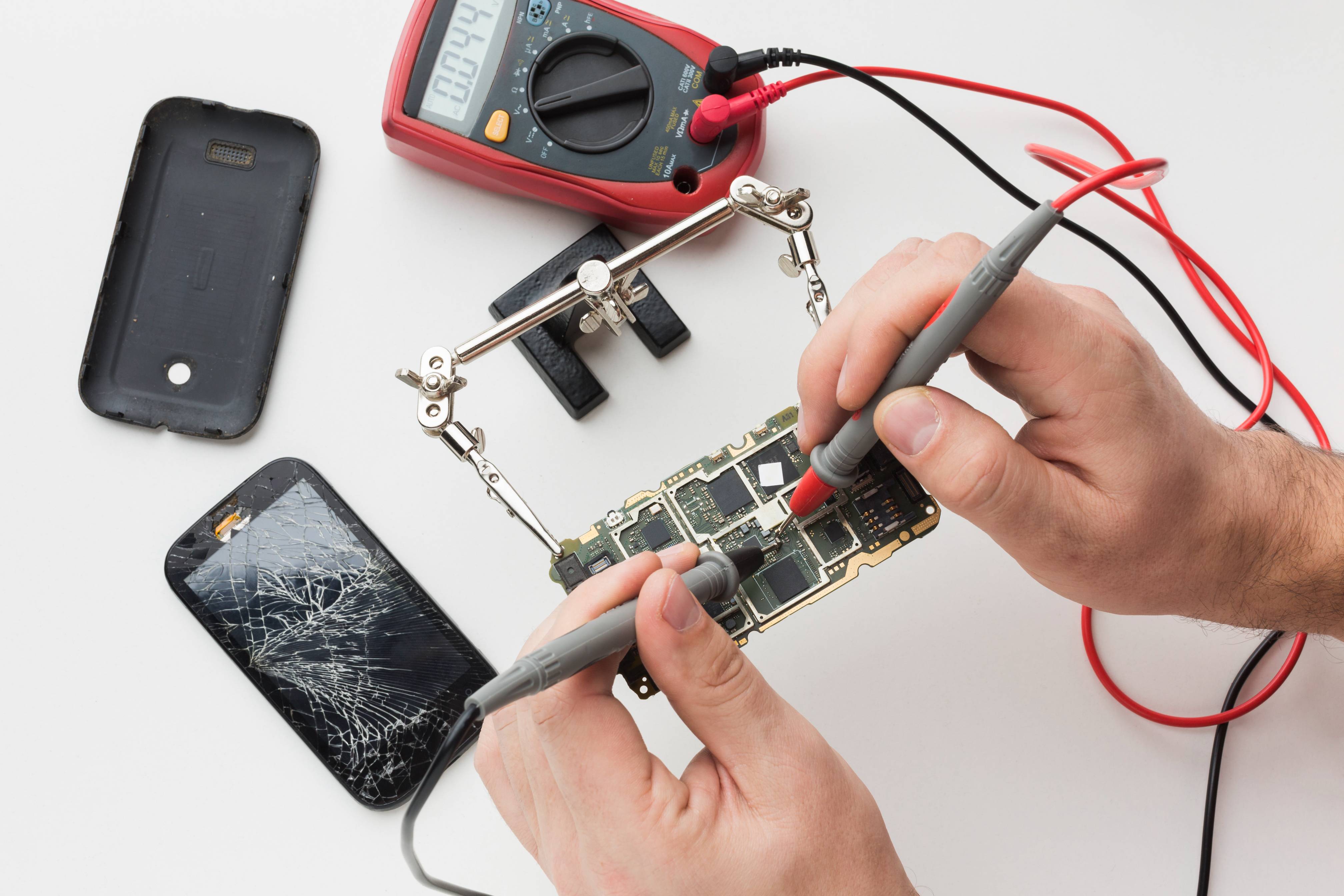
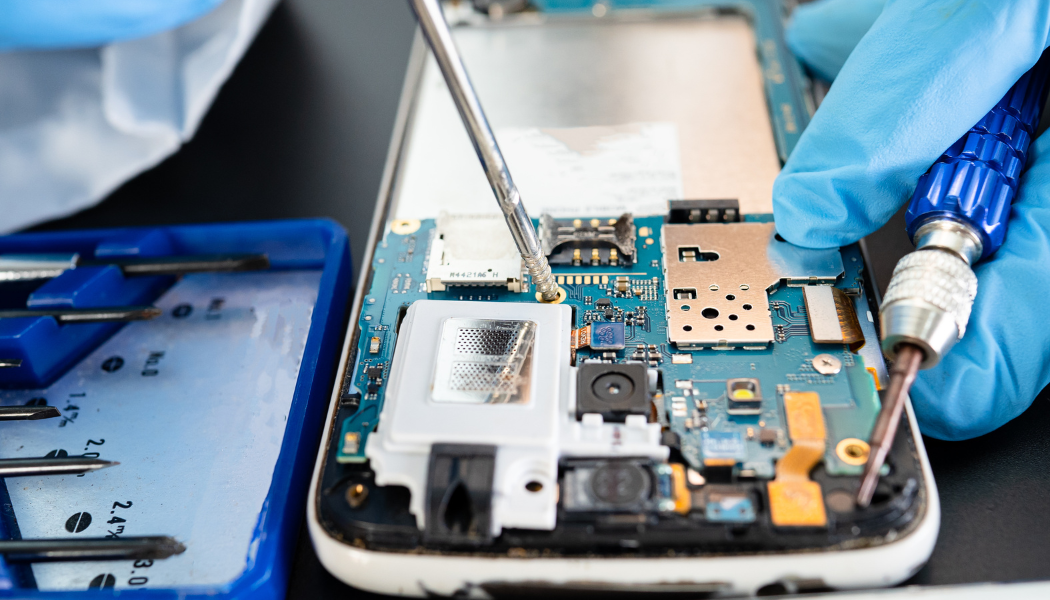
Through practical training in Smartphone & Laptop Chip-Level Engineering, students can develop knowledge in areas such as smartphone hardware, motherboard-level technology, fault diagnosis and professional repair techniques.
Devices like the iPhone 18 Pro and Samsung Galaxy S26 Ultra show just how quickly smartphone engineering continues to evolve.
Today's smartphone user sees a camera, display and apps.
A trained technician learns to see the technology behind them.
 Magnus Forum